Also a History of Philosophy
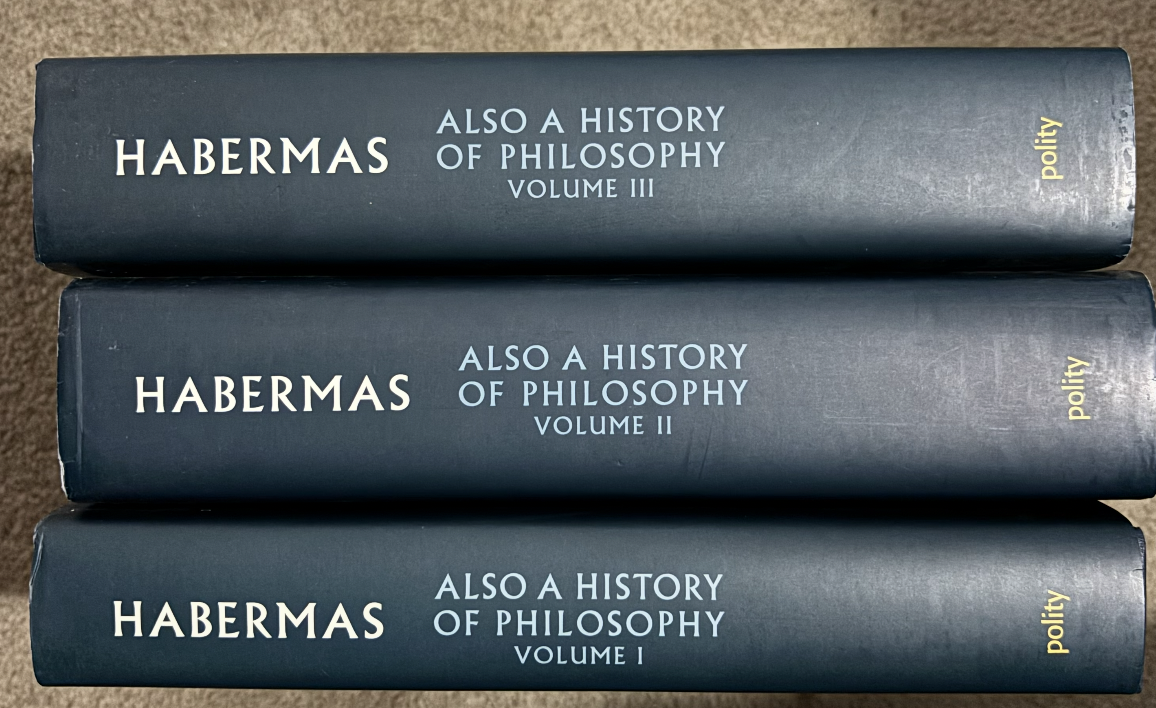
My wife gifted me the three volumes of Habermas's Also a History of Philosophy for Christmas today. I am going to actually try to challenge myself to read but also blog each day about whatever I read. Would be a good exercise but also interesting to see the pace of reading a large collection of books each day. It is also a good book to do this since it relates to some of my current readings but also the format of going through each age, starting with the pre-philosophy of the sacred and religion. It also engages with Girard, who, Habermas disagrees with it looks like, but is interesting for a philosopher to engage with. I did not expect Habermas to agree with Girard's narrative anyway.
I have not read much of Habermas. I have read one of his lectures he gave with Joseph Ratzinger (Pope Benedict XVI) in the book The Dialectics of Secularization: On Reason and Religion, but most of the work I have read are American scholars engaging with Habermas.
I haven't really done this before. I mark up my books quite a bit. I will probably use it as a way to reflect more than 1:1 map the mark ups, expand on the little shorthand mechanisms I make in the margin, and reference other works that I am thinking of in relation to the text.
Final note: I stopped taking notes after section 2. They are in my book, but typing them all up again will take awhile. It was a good run, but life gets in the way and it is not my full time job here. Typing up and reflecting on even a chapter is a multi-hour process. At the current rate, I wouldn't finish even writing up the notes for some time. Maybe there is a world where I write more in my Remarkable for reading, or use some sort of voice note-taking-system to capture thoughts. The hard part is retyping up the thoughts after the fact, expanding on the short hand I use, and also re-typing the passages. I could just cite the page itself, but that gets hard as well to cross reference for anyone reading let alone myself while I am doing it.
The remaining chapters were still interesting, but some of my core critiques still stand here. I would like to read more of the some of Eliade's work on myths and rituals to evaluate Habermas's claims about the sacred more thoroughly, but I think they will not capture the full breadth of the sacred.
There is a whole wider reading list of religion, myths, anthropology, and philosophy that this is a part of, and I think the Habermas three volumes will be a part of those going forward, on whatever I end up deciding to write about.