Post-Secular Reason
· 7 min read
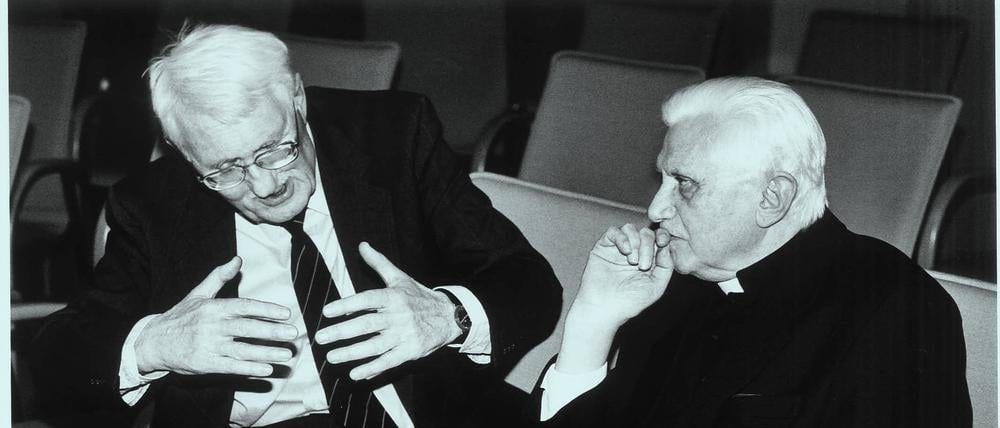
At one point, the debate between religion and reason was the most important one that the West could engage in. Whether it was the problem of evil, the French Revolution, Kant's Critique of Pure Reason, the American separation of Church and State, there was always considerable importance around this debate. The conflict between the secular and religious persists today, for example, in the abortion debate.
If reason did not win the great debate, it is even more unlikely that religion won the debate. Or from a different angle, it does not matter what or who won this centuries long debate, it seems as if neither side did and something else won. Maybe the Chicago school of metaphysics was right, and it took over a century for Nietzsche's prophecy to play out in the world and prove itself true, that nihilism in the form of technological cybernetics is the dominant value system in the modern West.
Indeed, this is Nietzsche's prescription, and many of those after him, who think that this is what took over after Western religion and reasons's spots on the throne.
It seems odd that the 2004 debate of Joseph Ratzinger and Jürgen Habermas, collected in the book Dialectics of Secularization, a future pope and a living legend in philosophy, is barely discussed.
What was the Ratzinger and Habermas debate about? Mostly it was about the state, its justification, and its origins. Habermas opens with a quote from Ernst Wolfgang Böckenförde:
Does the free, secularized state exist on the basis of normative presuppositions that it itself cannot guarantee?
In particular, the concern for Habermas is that our modern democratic state is propped up by extra-normative considerations it cannot admit. In America and Germany, we see this in the increasing rejection of democratic norms. It is the hardworking American people that make up the state, the families who sacrificed brothers, sons, and fathers in the civil war. We are not bound to the Declaration of Independence or the constitution, but our red-blooded American brothers and sisters. It is, excuse the cliche, the blood and soil that make up the state and thus democracy and reason are subservient to the logic of those norms, not the norms of autonomy, freedom, human rights, etc. The extra-normative ties that Habermas is thinking of in this dialogue is religion, although religion is not the only form of non-constitutional solidarity.
Habermas argues for a fundamentally Kantian position. Any non-rational reasoning is deemed private, that is, a reason not in principle shareable by arbitrary others. In contrast, with public reason any person can participate, regardless of race, ethnicity, gender, or religion. Only this can build true solidarity and true pluralism. Religion can still exist with the state. If anything, the more pluralistic a religion, the easier it will coexist with the state and translate its private reasoning into public reasoning. For example, “love thy neighbor” becomes immigrant, refugee, and cosmopolitan laws.
Habermas wants to take seriously the challenge to reason's claim to primacy. What if modernization goes “off the rails” and erodes this extra-normative basis for solidarity, and democracy falls apart? Is that reason to prioritize the logic of the extra-normative solidarity over the democratic solidarity? Would people be upset or grateful if the president prioritized “Americans” over the constitution?
Habermas goes on an excursus at this point in his talk. This argument and line of thought in politics is paralleled in philosophy.
When critiquing reason itself and its foundations, some are led to go beyond reason and find that we must stay in the origins of reason. In philosophy, this is religion, religion predating philosophy, especially if we are thinking of philosophy in the modern secular sense. Although, there are people who move beyond philosophy into other areas, replacing religion with another point of origin, such as psychology, culture, biology, society, politics, etc.
Habermas does not go with those who go beyond reason, such as the post-Hegelians, into mysticism or Christianity. He thinks those attempts are more amenable to reason than the post-Nietzscheans, who abandon reason entirely for an imaginary, idealized archaic society.
Rather, Habermas sees a public and a private sphere, and reason is the language of the public, religion just one of the possible languages of the private. Public reason needs to be respected by private reason since it makes possible the coexistence of many different world views. Unlike Kant and Hegel, he says, Habermas's idea of public reason is humble, it need not make any judgements about what content is true or not in private reason, it just asks private reason to translate itself into public reason when appropriate.
Ratzinger's half of the book is not necessarily a direct critique, there is no back and forth “debating". His response is rather his perspective on the same moment in humanity.
The two main issues Ratzinger sees are precisely the same that Girard sees in his Battling to the End.
The first is that humanity is more interconnected than ever, we have managed to coexist peacefully enough to have such an interconnected world. In Europe, there used to be thousands of little tribes, kingdoms, and countries that fought each other for centuries. Although there are still fights and skirmishes, the level of interconnection, cooperation, and peacefulness has been proven through geopolitical events such as Covid, the Russian-Ukranian War, and the recent trade wars.
The second issue is that humanity has a near total capacity for technological violence. War has fundamentally changed since humanity now possesses technology capable of apocalypse.
There is a mirror here to Habermas's concerns. Our modern situation is fragile from two ends. For Habermas, the fragility is that our norms, which we take for granted and justify our laws with may only be made possible by extra-normative considerations that the law cannot appeal to. This undercuts the foundations of the law itself.
For Ratzinger, from the other end, the law is weakened when humanity has apocalyptic level weapons. Weapons that can be used to the advantage of those in possession of them such as the US and Russia, but also to the advantage of “rogue states” or terrorist groups who, if they can acquire the weapons, could upend the status quo.
Ratzinger's position is that humanity needs to go beyond science and scientific thinking. The crux of the issue is thus, what ground could a global idea of the good, a “global ethos” be grounded upon, if not science? For Ratzinger, it is Christ through the vehicle of the Catholic church. It would be out of character for the Pope to advocate otherwise.
Ratzinger's answers end up being very similar to Habermas. Both Habermas and Ratzinger worry about the law becoming something that is unjust yet sanctified by the majority.
What a majority (even if it is an utterly preponderant majority) oppresses a religious or racial minority by means of unjust laws, can we still speak in this instance of justice, or indeed, of law? In other words, the majority principle always leaves open the question of the ethical foundations of the law. This is the question of whether there is something that can never become law but always remains injustice; or, to reverse this formulation, whether there is something that is of its very nature inalienably law, something that is antecedent to every majority decision and must be respected by all such decisions.
For the pure philosopher, this is the major problem of political philosophy. Natural law theorists are ok with this. Arguably, this just pushes the problem to a new one where you debate what is indeed human nature, for example, the classic Hobbes vs Rousseau debate on what is the “state of nature”.
This debate is taken up as well in legal theory, the Hart-Fuller debate for example, on what the foundations of law can be, especially relevant in dealing with the a new class of crimes after WWII, the crimes against humanity. The philosophical debate on the grounds of law became concrete during the Nuremberg trials, since on what grounds could other nations punish Germany from a legal and non-military perspective.
This problem of the self-justification of law, the state, and modern democracy is also a problem of reason, reason made concrete. As Habermas notes, the extra-normative values he is concerned about are due to his allegiance to reason and its difficulty to reconcile itself with justifications outside of reason.
Ratzinger does not face this problem.
... is then religion a healing and saving force? Or is it not rather an archaic and dangerous force that builds up false universalisms, thereby leading people to intolerance and acts of terrorism? Must not religion, therefore, be placed under the guardianship of reason, and its boundaries carefully marked off? This, of course, prompts yet another question: Who can do this: And how does one do it? But the general question remains: Ought we to consider the gradual abolishment of religion, the overcoming of religion, to be necessary progress on the park of mankind, so that it may find the path to freedom and to universal tolerance? Or is this view mistaken? ... If we have noted the urgent question of whether religion is truly a positive force, so we must now doubt the reliability of reason. For in the last analysis, even the atomic bomb is a product of reason; in the last analysis, the breeding and selection of human beings is something thought up by reason. Does this then mean that it is reason that ought to be placed under guardianship? But by whom or by what? Or should perhaps religion and reason restrict each other and remind each other where their limits are, thereby encouraging a positive path?
Without it being an active dialogue, again this is something that Habermas himself predicts and accounts for. Habermas does not take the “decisionists” critique of reason to be damning (Schmitt, Heidegger) nor the so called structuralists (e.g. Levi-Strauss) nor the technological critique you might find in Adorno, that reason has produced monsters like the atomic bomb, losing the moral superiority it staked its claim on in the first place.
Ratzinger agrees. Reason will always have its place, especially alongside Christianity, in that reason helps to purify aspects of Christianity.
However, we have also seen in the course of our reflections that there are also pathologies of reason, although mankind in general is not as conscious of this fact today. ... Accordingly, I would speak of a necessary relatedness between reason and faith and between reason and religion, which are called to purify and help one another. They need each other, and they must acknowledge this mutual need.
This is the part that the champions of reason do not, and I wonder if, cannot commit to.